Credit: this is my take on Opus 5.5 is proof that we do need smarter models, a 31-minute video by Theo (t3.gg), published October 20, 2026. The quotes and claims about his own work are Theo’s. The checks and the opinions are mine.
Video: Theo (t3.gg). Published October 20, 2026.
The short version#
In August 2024 Theo posted a video called “AI isn’t gonna keep improving.” Later his position softened into something bolder: models might keep getting smarter, but most of us couldn’t use the extra intelligence anyway. This video is him saying he was wrong about that too.
What changed his mind wasn’t his own work. He says Opus 5.5 “didn’t necessarily unlock a lot of new capability for me.” What changed it was watching people who don’t code ship things they don’t understand: ported game maps, mashups of old Xbox games, tools for their friends. His line: “everyone can benefit from smarter models.”
I think he’s right, and I’d push it one step further. The people who gain most from this jump are the ones in between, and that has real consequences for anyone who sells software or software services to small businesses.
Smarter and cheaper in the same release#
Anthropic released Opus 5.5 on September 22. It’s priced at $4 per million input tokens and $20 per million output, 20% below Opus 5, and cache reads dropped 60% to $0.20. Anthropic says it costs about 40% less than Opus 5 on typical workloads, and it’s included in the Pro, Max, Team and Enterprise plans.
That last part is Theo’s real point. A model that does the hard stuff, priced so it fits in a monthly subscription, is what moved non-developers. He describes people paying “200 bucks a month” for Claude to port maps from old games they reverse engineered.
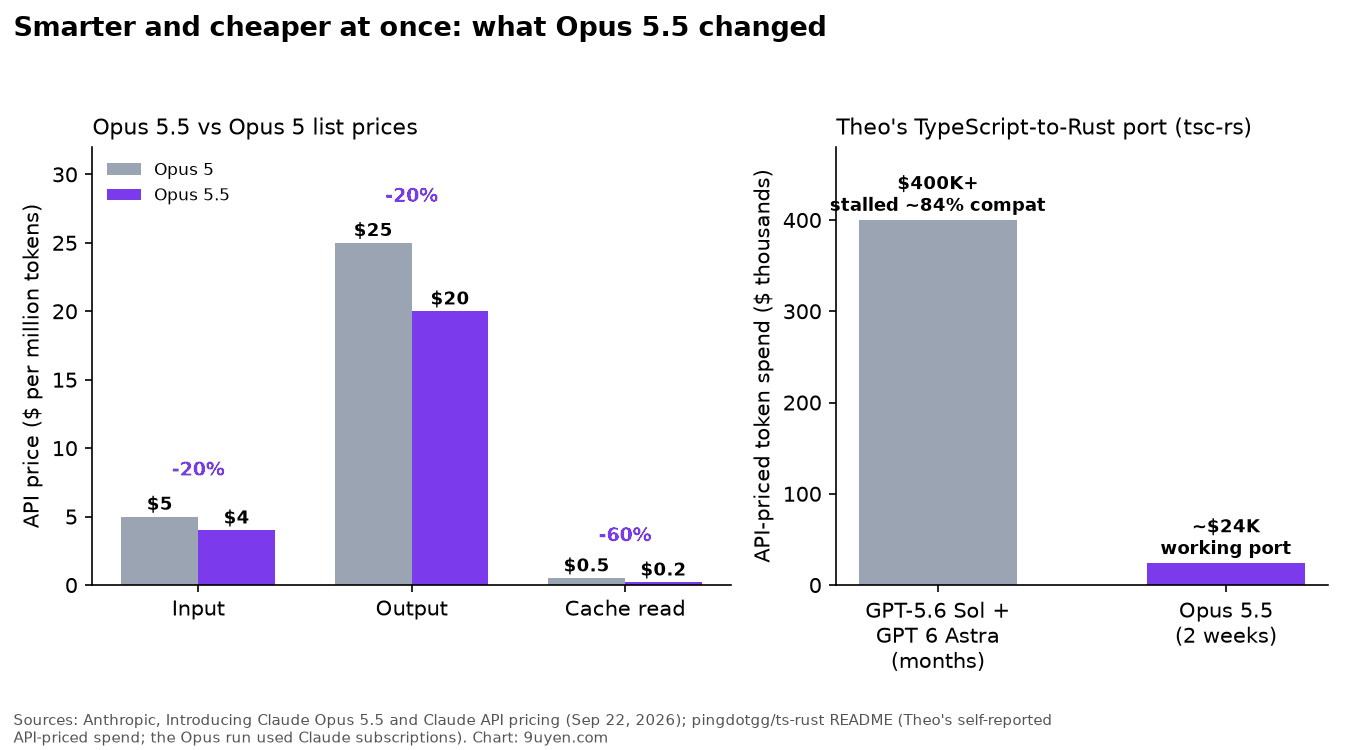
Sources: Anthropic, Introducing Claude Opus 5.5 and Claude API pricing; pingdotgg/ts-rust README (Theo’s self-reported spend).
His own benchmark is the TypeScript-to-Rust compiler port I wrote about earlier this month. Per the project README, he burned over $400,000 in API-priced tokens on OpenAI models and never got past about 84% compatibility. Opus 5.5 had a working first version in 10 hours and got there for about $24,047 of API-priced spend over two weeks. The README now says the port type checks about 2.1 times faster than the Go-based TypeScript 7 across the apps it tests.
One caveat Theo states in the README and skips in the video: he ran it on Claude subscriptions, and it used between 925% and 983% of his $200 plan’s weekly limits over those two weeks. The subscription is doing a lot of the work in “accessible.” Labs can change those limits whenever they like.
The four tiers, and where the jump landed#
Theo sorts what AI lets you do into tiers. First it helps with what you already do. Then it lets you customize your own tools. Then it builds things you don’t fully understand, like his Rust projects in a language he says he barely knows. At the bottom is the new tier: decompiling and rebuilding things nobody fully understands, like old console games.
He also sorts people. Professional developers. “Technical people,” his term for the smart tinkerer who knows computers but never coded for a living. And non-technical people.
His observation is that earlier jumps mostly helped developers go deeper, and he expected that gap to keep growing. Opus 5.5 did the opposite. It barely moved him, and it pushed technical people “deep, deep, deep” into building things they don’t understand. Non-technical people haven’t moved much yet.
Developers are the ones holding back#
The spicy part of the video is aimed at his own audience. He says developers aren’t very creative, and that years of knowing what “can’t” work now hold them back. The tinkerer who doesn’t know two game engines shouldn’t mix just asks for it, and the model does it.
He also says developers take rejection badly. A dev who spends two hours on an AI-written pull request still feels like they did a week’s work, and it hurts when it’s closed. A tinkerer who spent five hours on the same thing went in expecting to have fun, not to get merged. That difference, he says, is why tinkerers have been doing “crazy” things lately.
His own examples are about giving up preferences. He built Lawn, an open-source video review tool, in a few days because Frame.io got slow and expensive. Adobe paid about $1.24 billion for Frame.io in 2021, and Theo estimates Lawn covers about 70% of what it did then. And he’s building a custom Ubuntu image for his agents rather than for himself. He claims over 30% of the errors Claude hits on his machines came from zsh formatting newlines differently, so the agents get bash even though he prefers zsh.
What this means if you work with small businesses#
I build websites and AI agents for small businesses, so here’s the version of this I care about.
The person who fixes everyone’s computer is now a builder. Every small business has one: the nephew, the office manager, the owner who set up the Shopify store alone. Theo says they can now find their mom’s problems and build the fix. That’s also your client’s next competitor quote. If your whole offer is “we write the code,” that person now does a passable version for $200 a month.
What’s still worth paying for is judgment. The tinkerer builds fast and doesn’t know why the app got slow, which part is fragile, or what happens to customer data. Theo points out the models are starting to close those gaps too. They aren’t closed yet. Right now the value is knowing what to ask for and saying no to what shouldn’t ship.
Throw work away faster. If a draft costs an agent an hour, closing it shouldn’t feel like killing a week. I agree with Theo here. Teams that treat agent output as cheap drafts will go further than teams that guilt-merge it.
Don’t build the plan on subscription pricing. The cost curve is real: Opus 5.5 is both better and cheaper per token than Opus 5. But Theo’s own run used nine to ten weeks’ worth of a $200 plan’s limits in two weeks. If a product only works because a lab’s flat fee is generous, it has a risk the founder doesn’t control.
Theo closes by saying he was wrong and “we are very, very early still.” The tool that can write a compiler turned out to matter most to people who want their old games back. That’s a good reason to stop guessing who the next model is for.
Sources#
- Theo (t3.gg): Opus 5.5 is proof that we do need smarter models, AI isn’t gonna keep improving (Aug 2024)
- Anthropic: Introducing Claude Opus 5.5, Claude Opus availability, API pricing
- GitHub: pingdotgg/ts-rust (tsc-rs) README, pingdotgg/lawn
- Adobe: Adobe completes Frame.io acquisition, FY2023 10-K acquisitions note
- Earlier on this site: Theo had agents rewrite TypeScript in Rust for about $24K