Every web designer hunting for a first client has done the same thing. You open Google Maps, scroll until you find a business with a site that looks like 2009, and think: they need me. You are right. They also have no budget, no urgency, and no idea what a website is supposed to do for them. That email goes nowhere.
The Boring Marketer argues the opposite list is the one that pays. The worst website in town “needs the most help,” but it is “also the business least likely to pay for it.” The better targets are the biggest businesses that are still busy and still getting reviews. They have money, and they have customers to lose.
I am looking for Scrutoire’s first paying customer right now, so this hit close. My instinct has been to sell redesigns to people with bad sites. That is selling to the people with the least reason to say yes.
The filter does most of the work#
The test in the issue used roofers in Tampa. Start with every roofer on Google Maps, then keep only the ones that are among the biggest in town, have 4+ stars with 10+ reviews and new ones still coming in, run their own website, and are not chains or franchises.
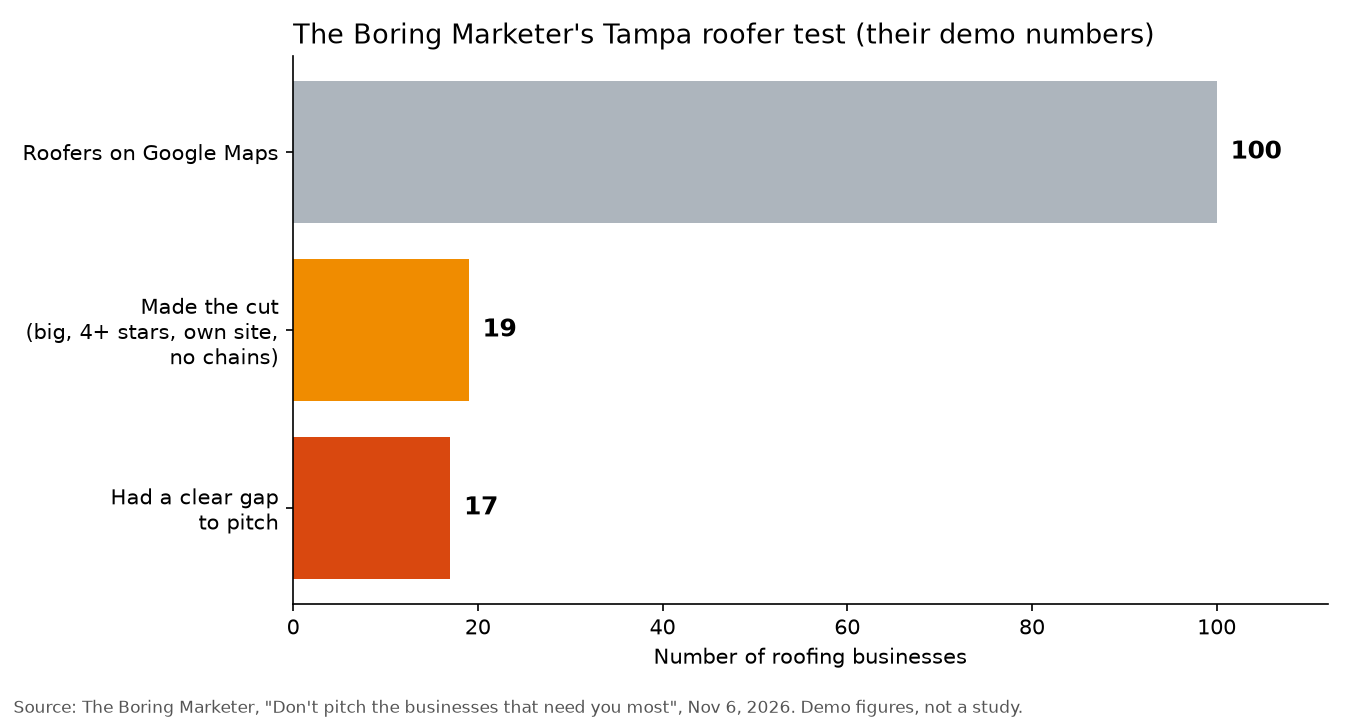
Tampa went from 100 roofers to 19. Of those 19, 17 had a clear gap worth pitching. Those are their demo numbers from one search, not a study, but the shape matters: the businesses that look healthiest from the outside were still leaking almost across the board.
That flips the usual pitch. You are not telling a struggling owner their site is ugly. You are telling a successful owner that money is falling out of a specific hole.
Look where their customers actually land#
The check happens on a phone, because that is where people arrive from a Google ad or a search. Look at the first few screens and write down what is missing: a buried phone number, reviews far down the page, a pop-up in the way, an ad promise the page never repeats, slow loading.
The Tampa examples are the kind of thing an owner cannot ignore. One roofer’s Google ad opened a page that does not exist. Another’s ad promised same-day leak repair, and the website never said it. Both are paying for clicks and losing them on arrival.
This is the part I like most as a designer. It turns “your site could be better” into one fact the owner can verify in ten seconds on their own phone.
The comparison is the pitch#
A gap alone is easy to shrug off. A gap that competitors do not have is not. In the issue, the second roofer mentions its 4.9 stars in a sentence, but no stars or reviews appear until screen 10. Meanwhile 10 of the 16 roofers in the search show their Google rating in the first three screens.
That sentence goes straight into the email. Then each business gets its own email with its biggest gap, the comparison, and a picture of its own first screen with the fix in place, sent from your own inbox. Not just the top pick. All 17.
The obvious worry is that showing the fix lets the owner do it themselves. The Boring Marketer’s answer: most won’t, because they have no time and nobody to do it, and the mockup shows exactly what they get if they hire you.
What I’m changing for Scrutoire#
The issue ends by selling boringfunnels, its own tool, which it says did the Tampa list, checks and comparisons in about 2.5 minutes. You do not need it to use the method. A spreadsheet, Google Maps and a phone will get you the same list slower.
What I am taking:
- Build the prospect list from the top of the market, not the bottom. Busy, well reviewed, independent.
- Sell one fix, not a redesign. A first client says yes to a small, provable change faster than to a full rebuild.
- Lead with what the customer sees on a phone, and back it with what competitors already do.
- After a yes, fix that one gap and check it on a phone again. That before and after is the case study a new agency does not have yet.
The trap for a new agency is pitching where the pity is. The money is with the businesses that are already winning and do not know what they are losing.