Credit: this is my take on Dylan Field: Is AI Replacing Designers?, Design is the New Code & Democratizing Creativity, a 41-minute interview from the All-In Podcast, published October 19, 2026. The quotes are Dylan Field’s. The financial checks and the opinions are mine.
Video: All-In Podcast, with Figma CEO Dylan Field. Published October 19, 2026.
The short version#
Dylan Field made a public prediction a few years ago and now says he got it wrong. He told Figma’s Config conference that AI would raise the ceiling of what designers could make. In this interview he takes it back: “AI is not raising the ceiling. Humans are raising the ceiling.”
What AI did instead was lower the floor. Code, motion, video, layouts: anyone can now produce something passable in minutes. Field’s conclusion is his slogan, “design is the new code.” When code is cheap, the thing that makes a product stand out moves up a layer, to design, brand, and a point of view.
I mostly agree with him. I run a small web design studio, so I’d like to. But the more useful part is in Figma’s own filings. They show both halves of his argument, including the half he didn’t spend much time on: someone has to pay for the floor.
The scare that didn’t show up in revenue#
On April 17, Anthropic launched Claude Design, a tool that turns prompts into prototypes, slide decks and marketing assets. Figma’s stock fell about 7% that day, per The Register. Three days earlier, Anthropic’s chief product officer Mike Krieger had resigned from Figma’s board, per VentureBeat. The online verdict was that Figma was finished.
Field’s answer on the show was calm, with a little edge. He called it “a weird bout of communication” from a company scaling unusually fast. Then the line I’d underline: “I think it’s easy to mistake model progress for product progress.”
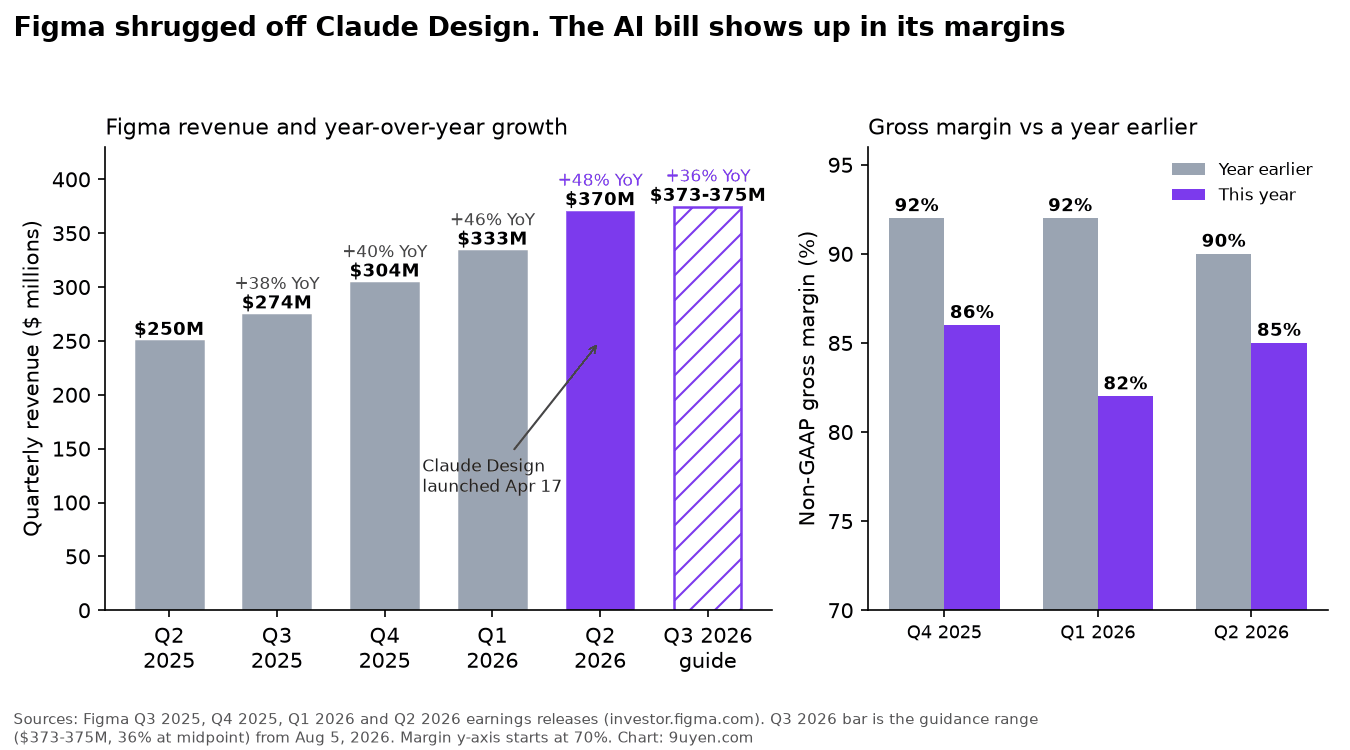
The numbers back him. Claude Design landed in the middle of Figma’s second quarter. That quarter’s revenue was $370.1 million, up 48% year over year, the third quarter in a row of faster growth. Net dollar retention was 136%. Over 80% of customers paying more than $10,000 a year were using AI credits every week.
So a professional tool that took more than a decade to build didn’t get replaced by a research preview. Field’s explanation is that it’s simply “hard to make good design tools for professionals.” The feel and the workflows are the product. That fits what I see with clients. A prompt gets you a first draft. Getting it shipped, approved, and on brand is a different job.
Now look at the right side of the chart#
Here’s the half of the story the interview skipped. In that same 48% quarter, Figma’s cost of revenue more than doubled, from $27.9 million to $60.5 million. Non-GAAP gross margin fell to 85% from 90% a year earlier. In the first quarter it was 82%, against 92%.
Figma’s CFO Praveer Melwani said why on the earnings call. Figma doesn’t charge for products still in beta, so “we bear the cost of inference without offsetting consumption revenue.” Investors noticed. The shares fell 16% after hours on results day, per Reuters, even with a raised full-year forecast. And the company guided the third quarter to 36% growth, down from 48%.
This is Field’s floor argument showing up on an income statement. Lowering the floor isn’t free. Every “make me a first version” button runs a model, and the company with the button pays the bill. Figma’s fix is to route tasks to cheaper models, use its own models where it can, and charge for AI credits. That last part helped: margin rose 2.5 points from the first quarter once credits were billed for a full quarter.
The lesson isn’t that Figma is in trouble. It’s that “everyone can make things now” has a running cost, and in software that cost lands on whoever offers the generation.
The part worth stealing#
The best idea in the interview is small. Field says Figma asks staff to put “written with AI” at the top of any document AI helped write. People joked about it internally, he says, but they do it. The reason he gives: when you see something unlabeled, you can trust a person cared enough to make it.
He also says he keeps getting decks that someone clearly generated and may not have read. That’s my inbox too. When average output costs nothing, the scarce thing is proof that a human made a choice. A label is the cheapest proof there is.
His working method is just as practical. Use AI to get past the blank page, react to what comes out, then go do the parts you have a vision for by hand. If you hand your vision to the model, he says, you get its version, pulled toward the middle of its training data. That’s the floor again. It looks fine and nobody remembers it.
Where I’d push back#
Two things.
First, “design is the new code” is also a sales pitch. Figma sells design seats, and it now sells AI credits that lower the floor too. It wins either way. That doesn’t make the slogan wrong, but read it knowing who says it.
Second, a small fact check on the Adobe story. Field says regulators held the $20 billion deal up for 16 months. Adobe announced it on September 15, 2022, and the two companies called it off on December 17, 2023, with Adobe paying Figma a $1 billion termination fee. That’s about 15 months. His Roomba example holds up: Amazon and iRobot called off their deal in January 2024, and iRobot went through Chapter 11 in late 2025, ending up owned by its Chinese manufacturer, Picea.
What I’d do with this#
If you run a studio or a small product team, stop pricing for production. Clients can get a passable homepage or deck from a prompt now, and they know it. Price for the part above the median: the point of view, the brand decisions, and the edits a model wouldn’t make on its own.
If you sell an AI feature, build the inference bill into the price on day one. Figma can absorb a few points of margin. Most small businesses can’t.
And try Field’s label for a month. Mark what AI wrote. People will read the unmarked work more closely, and that’s the point.
Sources#
- All-In Podcast: Dylan Field: Is AI Replacing Designers? (video)
- Figma: Q2 2026 results, quarterly results archive (Q3 2025 to Q1 2026), Q2 2026 earnings call transcript (Motley Fool)
- Reuters: Figma shares slump on AI costs, Adobe shelves $20B Figma deal
- The Register: Anthropic debuts Claude Design
- VentureBeat: Claude Design and Krieger’s Figma board exit
- Adobe: Form 8-K on merger termination
- iRobot: Amazon deal termination, Picea transaction completed