The other side of the price collapse#
Yesterday I wrote that the $132M token bill was fake but the price collapse behind it is real. The cost of a fixed level of intelligence is falling by 10x and more in weeks. That piece was about the buyer. Today is about the seller, because the obvious next question is the one that has been hitting AI stocks all month: if tokens keep getting cheaper, doesn’t the company selling them make less?
Anthropic’s S-1, filed with the SEC on Monday, gives the first hard answer from inside a frontier lab. It says no. Not yet, anyway. Milk Road Stocks put it bluntly in their newsletter, Wait, cheaper AI is good for Anthropic?, and spent a good chunk of the show above on it. I went through the filing on EDGAR myself, because this is the number I quote clients against at Othermind.
Prices really are falling#
Start with the bear case, because it is real.
Ramp’s AI Index tracks what businesses on its cards pay for OpenAI and Anthropic tokens. In the week ending October 23, the blended price was $0.56 per million tokens, down 26.8% from $0.76 a month earlier. Token volume rose 37.1% over the same weeks. Token spend rose only 8.9%. That gap is the whole fear in one line: people use a lot more AI and pay only a bit more for it.
Anthropic is cutting too. The S-1 says Opus 5.5 cut customers’ cost per task by about 40% versus Opus 5, and Fable 5.1 cut typical workloads by about 25%, with savings up to 45% on complex coding and agentic tasks. Both shipped in September.
If you sell tokens, that should hurt. Here is what happened instead.
Revenue per compute dollar went up 5x#
The S-1 breaks out revenue and “compute and infrastructure” expense for each of the last six quarters. That expense covers everything the models run on: research, training, serving customers, and Anthropic’s own internal Claude use. Divide one by the other and you get a simple efficiency number: how much revenue each dollar of compute brings back.
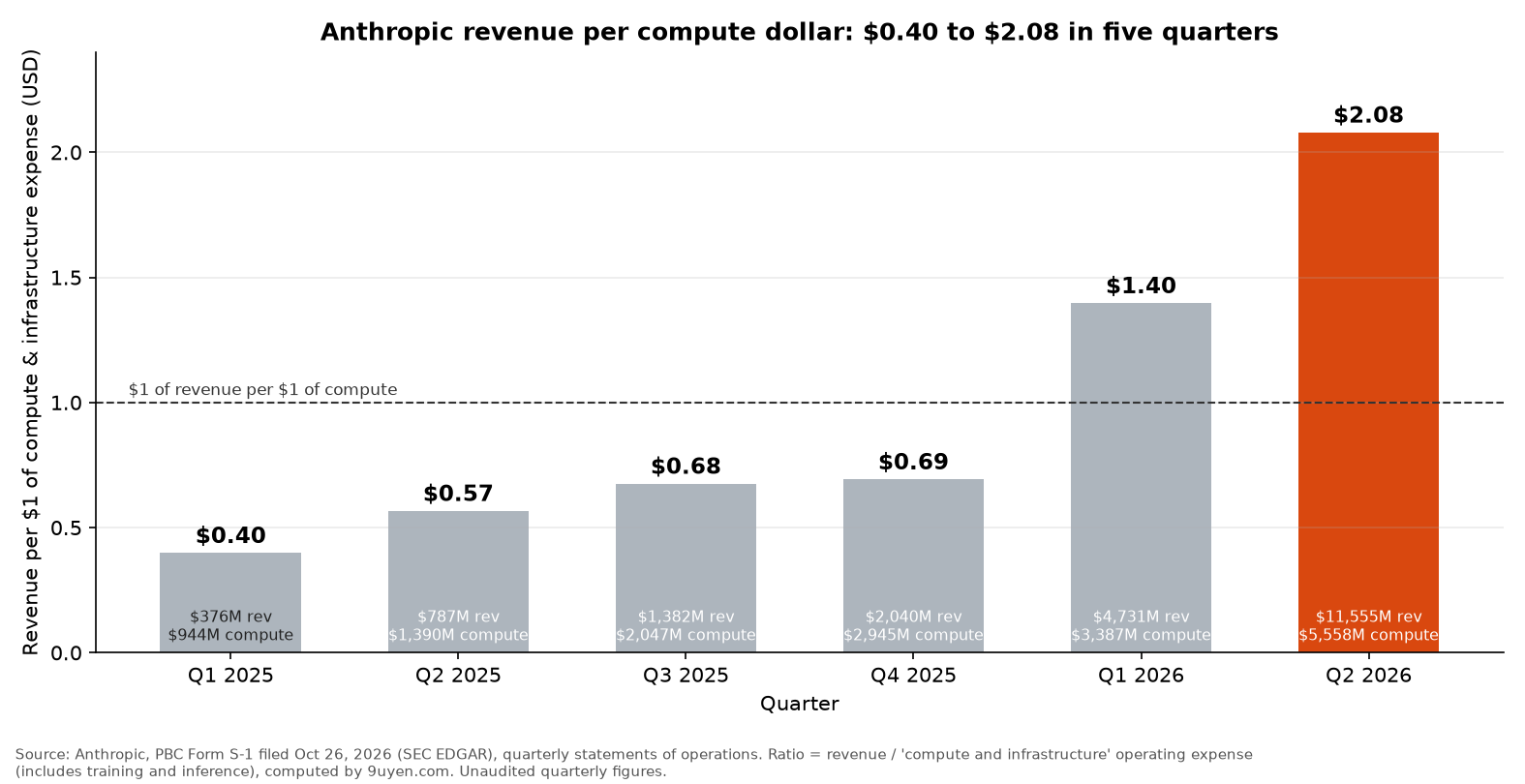
In Q1 2025, Anthropic brought in $376 million of revenue on $944 million of compute. That is $0.40 per dollar. In Q2 2026, it was $11.6 billion of revenue on $5.6 billion of compute. That is $2.08 per dollar, about 5.2x better, and the first time the line crossed $1 was only this year. The filing makes the same point its own way: Q2 revenue grew 1,368% year over year while compute expense grew 300%.
So prices fell and the margin on the compute got wider. Anthropic’s explanation is that newer models do tasks more efficiently, so it can cut what customers pay per task “while preserving our margins.” The price you see is per token. The cost Anthropic carries is per unit of compute. Those two can move in opposite directions, and right now they are.
Cheaper made customers spend more, not less#
The second half of the answer is demand. The S-1 puts net revenue retention at about 900% as of September 30. Customers who were paying a year ago now pay roughly nine times as much. More than 1,900 customers pay Anthropic over $1 million a year, and more than 11,900 pay over $100,000, up from about 950 a year earlier.
Revenue for the first half of 2026 was $16.3 billion, against $1.16 billion in the first half of 2025.
The detail I keep coming back to is about Claude Code. In Q3, Claude Enterprise users who did not use Claude Code spent under $75 a month on average. The top 5% of users who did use it spent about 20 times that. Agents eat tokens. Cut the price of a token and someone hands the agent a bigger job. That is exactly what I see with small business clients: the bill does not shrink when prices drop, the scope grows.
Ramp’s data shows where that spend goes. Anthropic’s own blended price fell less than OpenAI’s over the month (15.7% versus 42.4%), yet Anthropic’s share of token spend on Ramp jumped from 51.3% to 60.5%. Buyers are paying a bit more per token for the model they think does the job.
Profit, with an asterisk in the right place#
You may have seen the $80.7 billion net loss for the first half. About $72.4 billion of that is a non-cash change in the fair value of convertible notes and similar instruments, which rose because Anthropic’s valuation rose. It sits below the operating line.
The operating numbers are the ones to watch. Q2 2026 was the first of the six quarters in the filing with an operating profit: $974 million, an 8% margin. The first half as a whole still shows a $693 million operating loss, because Q1 lost $1.7 billion. Operating cash flow was $3.9 billion for the half.
Anthropic itself warns this will wobble. When demand outruns its long-term contracts, it buys short-term compute at a higher price, and the filing says it expects that “to compress our operating margin” in the near term. It also says plainly that it does not expect revenue to keep growing at anything like current rates.
The six-month shelf life#
Every’s Grant Harvey pulled out the line that worries me most in Every Model Has a Six-month Shelf Life Now. Per the S-1, model versions released in the six months to September 30 earned over 80% of Q3 revenue. Flip it around and models older than six months earned under 20%.
That is the moat and the risk in one number. The revenue per compute dollar only keeps climbing if each new model is clearly better and cheaper per task than the last one. Every’s Mike Taylor summed up the first half: “This is all Opus 5 money.” Miss a release or two, and a business built on multi-year compute commitments, many of them non-cancelable, is suddenly paying for capacity the old models can’t sell.
The catch: you get the economics, not the votes#
Here is what Milk Road’s Vincent flagged as his reason not to buy the IPO, and I agree it deserves more attention than it is getting.
Anthropic plans to list Class A shares on Nasdaq as ANT. Right before the IPO it will issue a single share of Class F stock to an LLC owned by its seven co-founders, including Dario and Daniela Amodei. That one share carries 50.1% of the total vote on matters that go to stockholders, including electing every director the Long-Term Benefit Trust doesn’t pick. The Trust, through its own share class, elects a majority of the board, which is why the filing calls Anthropic a “controlled company” under Nasdaq rules, free to opt out of some governance requirements.
Public shareholders get the revenue per compute dollar. They do not get a say in how the $5.6 billion a quarter of compute gets spent, or in what the next model is.
What I take from it#
For anyone building on these models, three things.
Prices falling does not mean your bill falls. Anthropic’s numbers are the clearest proof yet. Lower price per task leads to bigger tasks. Budget for scope, not just rate.
Plan for the six-month model. If 80% of the vendor’s revenue comes from models under six months old, your default model will change twice a year. Keep an eval of your real tasks ready and rerun it on every release.
Watch the vendor’s leverage. Anthropic is gaining share while cutting prices less than OpenAI. That works for it as long as its models stay clearly ahead. If you have one vendor, that is your risk too.
Token prices are collapsing. Anthropic’s revenue per compute dollar went up 5x anyway. That is the most important chart in the S-1, and the cleanest answer so far to the “cheap AI kills the AI business” trade. It holds only as long as the next model ships on time.